


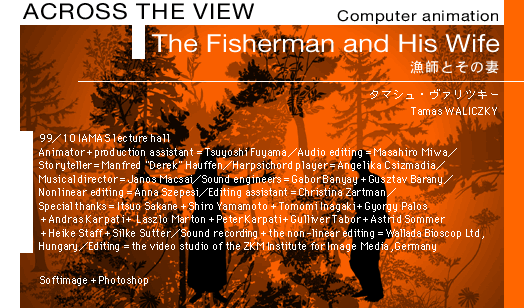

The "Fisherman and His Wife" is a 30 minutes long computer animation.
The story is based on a German folk-tale, collected and published by the Grimm brothers.
This story is well known in Europe, in several versions. The story has a repetitive structure,
and it ends at the same point where it was in the beginning.
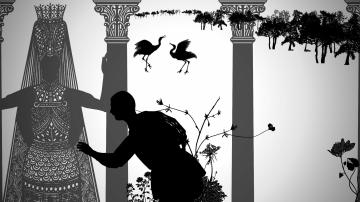
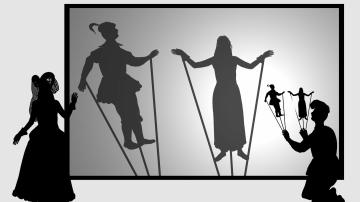
As In this animation , I use the method of shadow-pictures,
which were so popular in the romantic age
(the time period when the Grimm-brothers folk-tales collection was published in the first time)
in Germany. The work is an electronic shadow theatre in various fecets,
even on multiple levels. The work uses the light and the shadows to visualize relations between humans and humans,
humans and nature, to visualize reality and virtuality,
reality and wishes, reality and dreams.
(c) Tamas Waliczky and Anna Szepesi 1999-2000

During the last 4-5 years, I made a few shadow-theatre pieces for my daughter
and for the children of my friends. "The Fisherman and His Wife" is a
logical consequence of this kind of activity. It is a computer generated
shadow theatre performance.
The length of the animation was important for me. In a 3 - 5 minutes long video,
there is no possibility to show more layers and more aspects of a subject
at the same time.
In such a short time, we can only show one idea.
But the length of 30 minutes
or even an hour is different. Such length makes it possible to develop a more
complex structure. Therefore originally I intended to develop an hour long
animation. My idea was, that the computer technology nowadays let me do one
hour animation alone, or more exactly with the help of a few assistents. Till
the end of my 13 months long artist in residency period, I developped 67
minutes animation, but after the editing process the length of the video is
much shorter: it is about 30 minutes now. I am satisfied: from techical
point of view, the experience showed, that it is possible to generate one
hour computer animation alone or nearly alone. From artistic point of view,
the story - as I saw during the editing - was not interesting enough for one
hour. It was interesting enough for 30 minutes.
In connection with the previous problem, it was also important for me to try
to make a video in the same way, as a painter paints a picture, For example. I mean
I did not make storyboard, I did not make production plan or time schedule.
I started to make a scene, for which I had inspiration. During the
production of this scene I have got idea or ideas for other scenes. I made
them. Then all of a sudden I have got an idea how to visualize a different
part of the story. But then I went back and changed something on the scene I
made first. And so on.
The whole process was organic process. Every day I
had to re-think the whole story. Every day I had to ask myself "Is this
direction good, or should I go to a completly different one?" If somebody
makes a storyboard, the artistic activity ends when the storyboard is ready.
The rest of the film- or video-making process is just a dry production. I
wanted to keep the artistic process during the whole production time.
As a consequence of the above mentioned organic process, the editing of the
video was a very difficult and interesting process too. It was much more
than just to put the scenes in the right order. It was really a big
challenge.
I am very thankfull for the whole IAMAS to gave me enough freedom and let me
work in this way, and let me produce this new computer animation, called
"The Fisherman and His Wife".

|
Tamas WALICZKY |
Born in Hungary,1959. | |
 |
 |