



---Would you briefly explain the concept of your work??
Tamas When I first thought about the garden, my idea was to make an animation which shows a very strange point of view, that of someone who is the center of the world. The sizes would depend on his intentions as he moves through space rathr then some objective measure. But at the time I didn't have the technology for this.
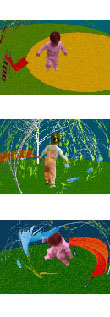
This idea stuck me again when my doughter was born. When my daughter was about 1 year old, she loved to go to the playground where other children were playing. In particular she adored the swing there. So I built here a small swing out of lego. Athough she was three times bigger, she wanted to sit on it. She had no sense of her size.
I then started to think about the distance..When we are children we don't have a well formed spatial system. Everything is just a flows in space.
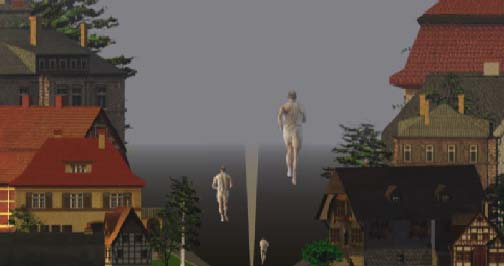
Wouldn't my perspective film-idea perfectly represent my daughter's sense of space? In the film you see how her perspective system distorts objects around her. However in the film, I do impose another projection system, my own. If I to show only my daughter's system, the final result would be a closed sphere. But in order to see her system, I need to make a second system that could project hers. But poetically, I prefer to look at the world through my daughter eyes.
The garden is a very complex viutual reality system, but I did not use any virtual reality technology. This was an important choice for if the viewer had to put on a helmet, he would be at the center of the world. controlling everything. In a word, fachism. I, always I. But I wanted to show somebody else's world, someone whom I like.On this secondary or third level, my film message is torelance. It could be interesting to see somebody else's dreams, or to see how somebody else recognizes the world.
---Why are you so much interested in perspective?
Once I saw a beautiful renaissance painting. It showed an adolencent girl, who displays a drawing of hers. It is a child's drawing, and it was exactly the kind of drawing that my daughter did. This means when we start to recognize the world, when we draw, we are absolutely identical. Later, as we start to understand, each of us makes system out and become different.
I concluded that, now we have a new toy, computer. The computer has different working principles from the camera. Vanishing points and view points are now numbers, parameters that I'm free to change. I realize that the computer is an opportunity to play with perpective systems.
---Your works seem to be based on argorithmic structures, very rigid structures. Could you describe the process of creating your works?
I always try to create a sort of structure, a mathematical or philosophical. As it takes shape, it works its way into the computer. Structure has its own rules, which let me do this or that but not other things. At this point, the work starts to live itself and build on its own. This dynamic of structure facinates me.
As it develops, the structure helps me to delete everything which is not my own idea. Of course I can do this because the structure is my own sort of child, but if I try to make my job very seriously, then I see, this structure is the structure of this film because it has the whole world inside of it.
---Would you give us, IAMAS students some advice to who wants to be a media artist?
Everyone has to answer this questions for him or herself. To be young is to be vital, ambitous, to strive for great power or fame, but these desires don't move a person for a long time. The whole story is something very different.
If students work with me, I can help them. To be good artist or good doctor or engineer, we have to devote whole life to this. But if somebody works with me, then day after day he or she can recognize both my weakness and my power, how stupid I can be, how lazy but they will also can recognize how I go on and, despite everything, finish my work. I have already made several works and some were very successfull. This is something what I know.
 |
Tamas WALICZKY |
Born in Hungary,1959. | |
 |
 |