

 JA
JAResearching Media Arts Education at IAMAS: Reflections from the Field
Introduction
In September 2025, I arrived at the Institute of Advanced Media Arts and Sciences (IAMAS) as a U.S. Fulbright Scholar and guest researcher to conduct research on media arts education. My broader field is art education, which extends beyond what is often understood in Japan as school art education to include learning in schools, museums, community settings, and other contexts related to art and visual culture. I consider media arts education to be one important area within art education.
I visited IAMAS because of its strong reputation for media arts and its distinctive interdisciplinary approach. My central question was how media arts education is understood and practiced here and what this might suggest about the broader meaning of media arts education. “Media art” remains an unstable category. There is no fixed definition of the term, and what counts as media arts education is equally unsettled. My background in art education in the United States led me to define media art broadly as art created using digital and electronic technologies, a framing that aligns with the National Core Arts Standards (NCCAS, 2014). This definition matters beyond the academic debate because it shapes what media arts education looks like in practice, including in K-12 school settings, where art teachers have limited guidance on teaching media arts. I expected media arts education to involve direct engagement with technologies, along with substantial studio time and structured technical exploration. I also expected technology to be visibly present in the classroom as an object of teaching and learning. These assumptions became an important part of the inquiry, since my experience at IAMAS gradually challenged and complicated them.
To investigate these questions, I participated in and observed daily life at IAMAS as fully as possible during my stay from September 2025 to February 2026. I took part in the project class Art of Listening (AoL), attended most General Studies classes, and observed work reviews, presentations, and the graduate exhibition. Attending Sougougaku was especially important because it revealed the breadth of disciplinary terrain surrounding media arts education at IAMAS, including contemporary art, aesthetics, philosophy, sociology, and media studies. I also interviewed faculty and students to better understand how they experienced media arts education at IAMAS. Because the analysis of interview data is still ongoing, this report draws primarily on my observations and participatory experiences. It is a reflective account of research in progress, not a presentation of final findings.
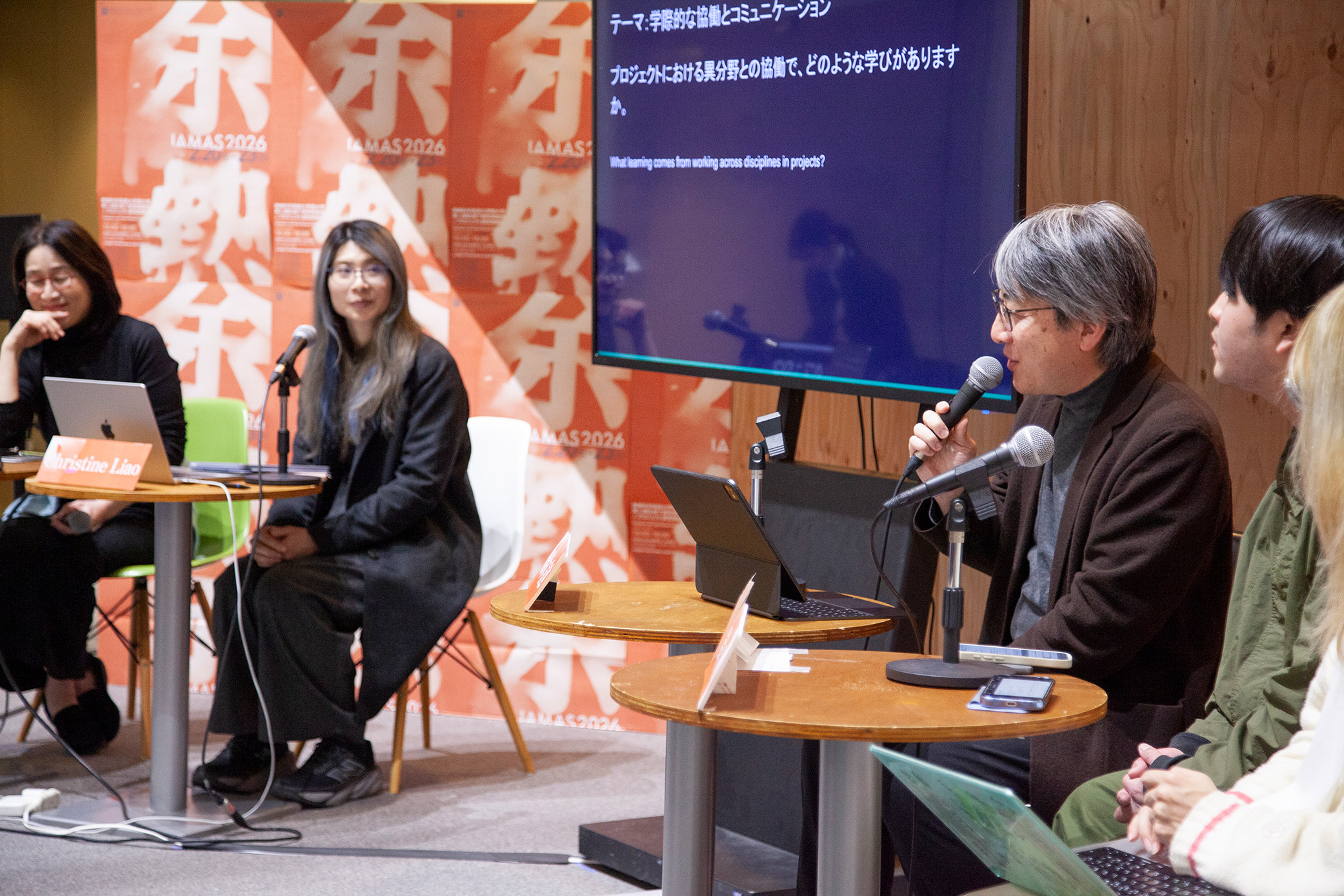
Christine Liao’s presentation and discussion at the graduation exhibition
Positionality
I interpreted everything at IAMAS through my experience as a scholar and teacher in the United States, and this shaped both what I noticed and what I missed.
Some pedagogical differences were immediately visible. The lecture-based format of Sougougaku and the absence of assigned readings before class surprised me because my assumptions about conceptual learning are tied to assigned readings before class and seminar discussion. I initially questioned the rigor of what appeared to be a more one-directional mode of instruction. Over time, however, I came to see that this format may reflect different assumptions about how students process conceptual material, including what kinds of learning take place outside class and how responsibility for synthesis is distributed between teaching and independent study. My outsider perspective made certain differences visible, but it may also have led me to overemphasize the absence of familiar forms of rigor while overlooking others.
My outsider status also created limitations I did not always recognize in the moment. During the review of second-year students’ graduation exhibition, for example, I found myself more attentive to the work being presented than to the pedagogical processes embedded in the review, such as how feedback was structured and how students were expected to respond. What was most visible to me was not always the most educationally significant. Language likewise played a role. When conversations depended on shared references I did not possess, my understanding was often delayed, and by the time I could enter the discussion, the moment had sometimes already passed.
Still, being an outsider allowed me to ask questions that may not surface easily from within the institution, especially about the relationship between IAMAS’s stated philosophy and its everyday practice. It also allowed me to notice aspects of IAMAS that insiders may take for granted. The sections that follow describe these observations.
Media Arts
Some aspects of IAMAS felt familiar. The philosophical and theoretical concepts introduced in Sougougaku were largely ideas I had encountered in art education. The practices of making work and creating exhibitions in the Media Expression class also felt recognizable. These moments gave me points of connection and initially suggested that some of the intellectual foundations of IAMAS were connected to my own disciplinary background.
Other parts of the educational structure felt much less familiar. The project class was perhaps the most unfamiliar. The class was not organized around a one-way transmission of knowledge from professor to student. Faculty and students investigated a shared theme together.
The Art of Listening became especially important in reshaping my understanding of media art, though this did not happen quickly. In that project, there was no fixed format for what students had to produce. Professors and students shared ideas, built conversations around the theme, and developed individual directions from there. At first, I found some of the student work difficult to place. A zazen session. An exchange of objects with strangers. I did not understand how these projects related to listening, and I had an equally difficult time understanding how they constituted art, let alone media art.
As students discussed project ideas in AoL, such as a zazen session, my instinct was to look for the technology they planned to use. I kept expecting each project to involve a form of technology that I could clearly identify as its medium. When I could not identify a concrete medium, I began to question whether these projects were appropriate for the class at all. Although I tried to understand these ideas through relational aesthetics (Bourriaud, 1998/2002), I still found myself asking how they related to the project theme.
My thinking began to shift as I continued to participate in the project. I noticed that the conversations kept returning to questions of how to create space for conversation. It was not simply about creating sound through technology but about the space and experience between people and the forms of mediation that shape that moment. The projects that had confused me began to make more sense when I stopped looking for technology and started looking for mediation and experience.
One student’s project helped me see the connection most clearly. She exchanged oranges for objects from other people and documented what she received in return. The objects and the act of exchange functioned as the medium through which conversation and experience were generated. Seen in this way, media art could be understood not simply as art made with technology but as art that works through mediated communication. Media, in this framing, were a means of communication, not limited to digital or electronic technology. This broader understanding of media resonates with media theory that treats media not simply as tools but as processes that shape perception and experience, as well as the ways communication takes place (McLuhan, 1964; Kember & Zylinska, 2012). What I encountered at IAMAS seemed closer to this broader understanding than to the more technology-centered definitions of media art.
Other experiences further complicated my understanding of media art. I did not see much visible technical training in the classes I observed, though I heard that some occurred in earlier semesters. Students seemed to explore technologies independently or seek help from peers, which made technology less visible as a defining feature of the classroom. I was also struck by NxPC, a club-like group made up of faculty and students and centered on live audiovisual performance. This further expanded my perception of media art, since I would have been more likely to classify such work within the performing arts, which is usually treated separately from visual art education. Taken together, these experiences suggested that media arts at IAMAS operate as a flexible field of inquiry.
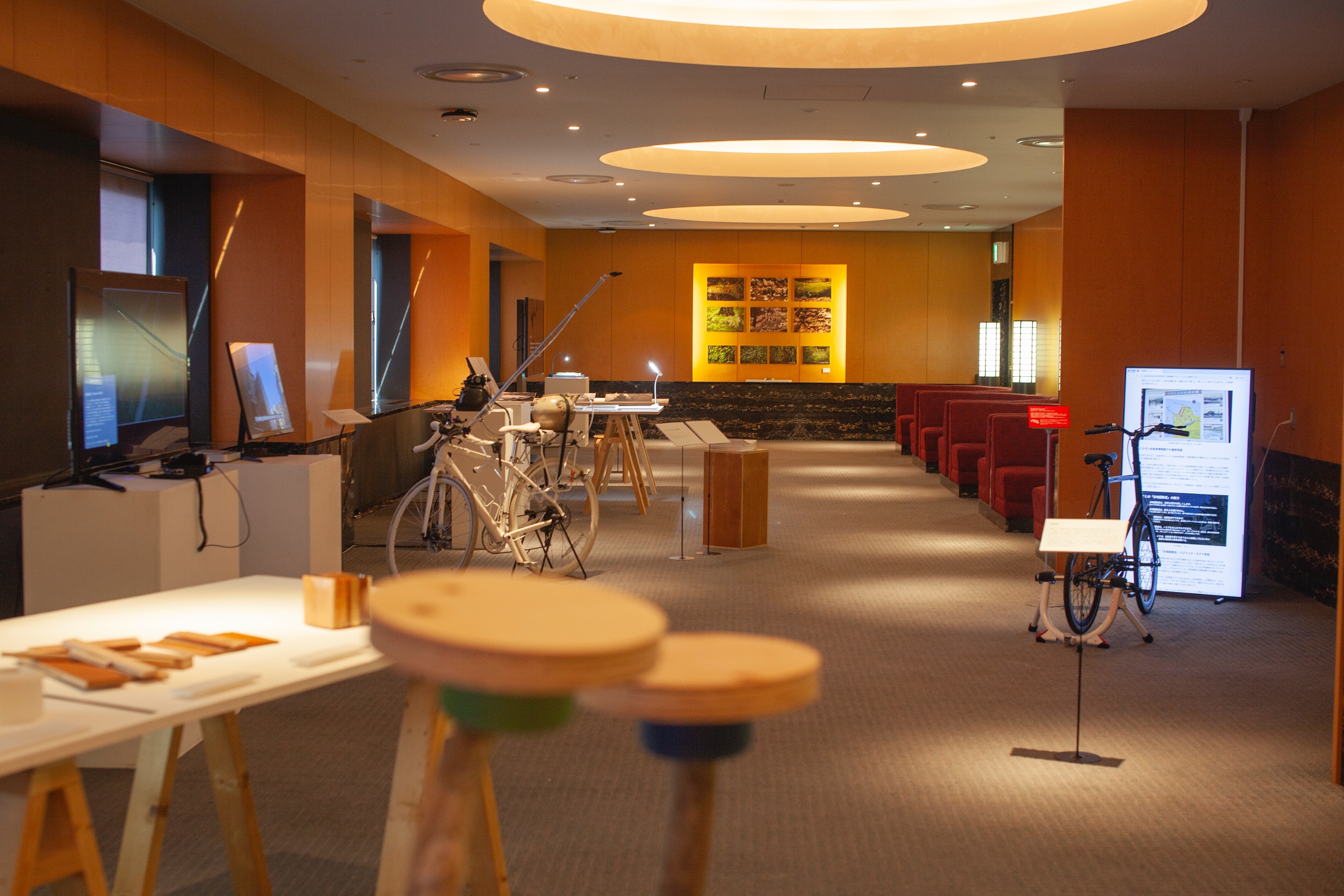
Projects showcase during the graduation exhibition
Interdisciplinary
Interdisciplinarity at IAMAS is articulated through formal curriculum, faculty composition, project structures, and the diverse backgrounds of its students. Project classes are co-led by faculty members and organized around shared themes of inquiry. Depending on the project, some require direct collaboration, while others allow students to pursue individual work within a shared intellectual framework. Beyond formal coursework, shared environments also play an important role. The loft, where students work and spend much of their daily life, places people from different disciplinary backgrounds into close and constant contact. The loft functions as more than a workspace. It created conditions for informal exchange, conversation across projects, and the kind of ambient exposure to other people’s thinking that is difficult to build into a curriculum but easy to lose without the right infrastructure.
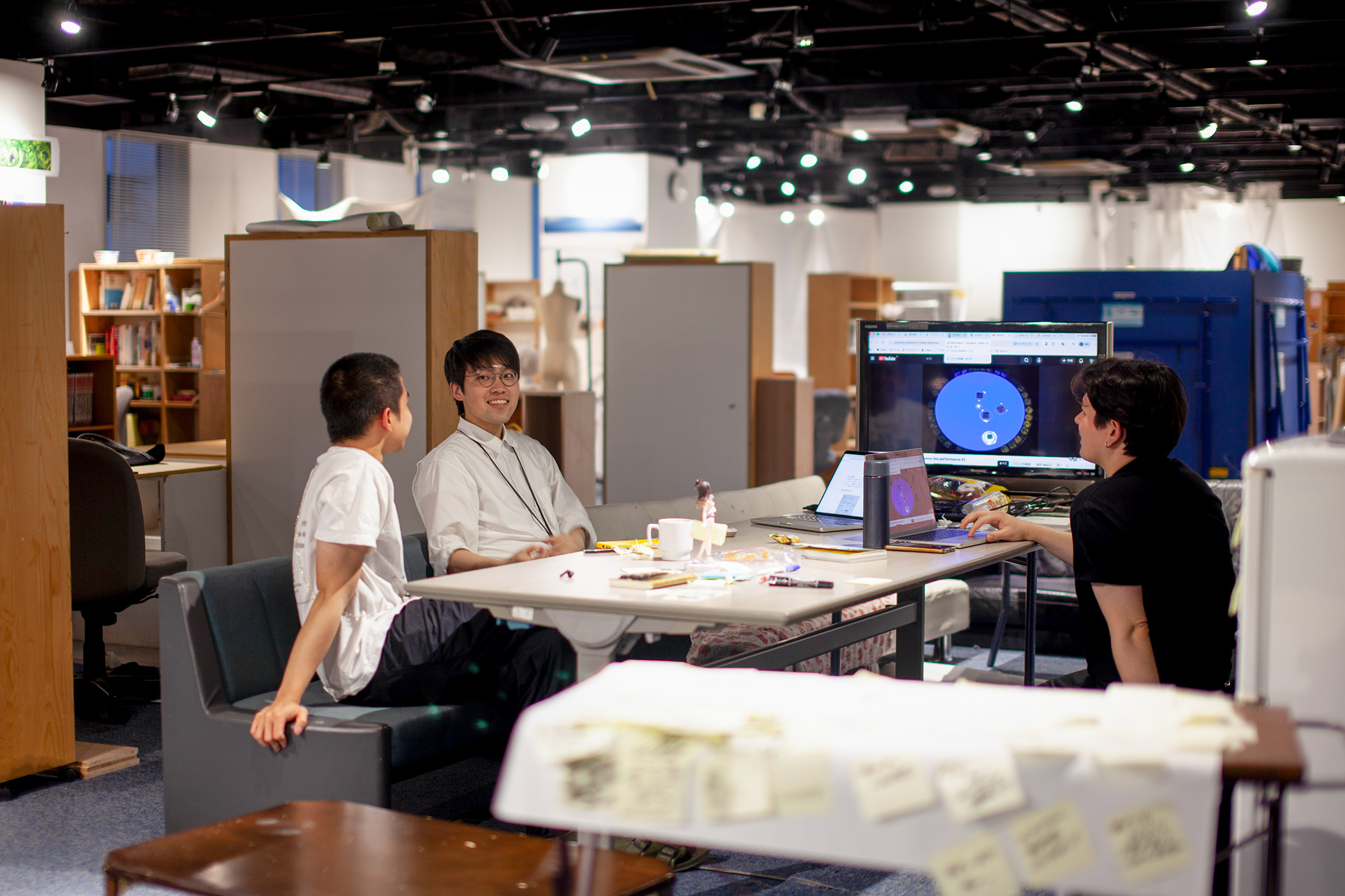
“The Loft” student research space
What seems especially significant is that these structures do not produce interdisciplinarity simply as occasional collaboration or a division of labor among specialists. Instead, they make it an everyday condition of learning. Students are expected to communicate their own ideas while also encountering, interpreting, and sometimes combining perspectives from beyond their original field. Interdisciplinarity, understood not just as the presence of multiple disciplines but as a form of engagement that requires working across different perspectives and forms of knowledge (Klein, 1990), operated at IAMAS as a daily practice of communication and negotiation through which students make sense of differences.
This differs from the way interdisciplinarity is often described or attempted in institutions more familiar to me. In my own institutional context, interdisciplinary work is frequently constrained by administrative and curricular boundaries (Lattuca, 2001). Even co-teaching within a single department can be difficult to arrange. As a result, interdisciplinarity often appears as an added layer placed on top of a largely disciplinary structure. At IAMAS, it is embedded from the beginning, in the curriculum, the infrastructure, and the daily conditions that support education.
Watching interdisciplinarity practiced in this setting further complicated my own understanding of what the term means. At IAMAS, “interdisciplinary” did not function primarily as a slogan or a category that required constant naming. It was embedded in the practice of learning and making. The more significant form of interdisciplinarity emerged when people from different backgrounds gained perspectives, knowledge, and sometimes skills from outside their original field. Interdisciplinarity was not only about combining disciplines, but also about learning to work across them without drawing firm boundaries around where one field ended and another began.
At the same time, interdisciplinarity at IAMAS was not seamless. In larger review settings, such as work reviews or thesis presentations, I observed that respect for other perspectives was an important shared practice. This respect created space for questions and comments to be exchanged without open conflict. Yet openness alone did not resolve the difficulty of communicating across disciplinary differences. One moment that stood out to me occurred during a first-year student’s end-of-year work review. In that discussion, a faculty member challenged the student’s use of terms such as “autonomy” and “relationships” to describe an algorithmic system. From the student’s programming perspective, these words appear to describe the system’s behavior. However, the faculty member pointed out that a system that randomly switches audio connections does not automatically constitute “autonomy” or a “relationship” in a social or philosophical sense. What struck me in this exchange was not simply the correction of terminology but the way different disciplinary assumptions were being brought into contact. A concept that sounds adequate in one framework became insufficient in another. The critique also showed that this kind of work requires recognizing that words, concepts, and evaluative criteria do not remain stable when they move from one disciplinary context to another.
This also helped me understand one of the tensions of interdisciplinary education at IAMAS. In conversations with students, I heard that discussions sometimes did not connect and that specialized terminology or highly abstract thinking could make deeper engagement difficult. The critique scene above shows why this happens. Interdisciplinarity depends on openness to other perspectives, but such openness does not automatically overcome the challenge of communicating across different vocabularies and assumptions. Interdisciplinarity at IAMAS often looked less like a smooth synthesis than an ongoing effort to bridge partial understandings.
From this structure, students gained more than exposure to multiple disciplines. They also had to learn how to navigate gaps in understanding, respond to differences, and make their own work understandable across fields. Interdisciplinary education at IAMAS seemed to cultivate more than technical or conceptual knowledge; it also cultivated the ability to translate, negotiate, and continue working even when full mutual understanding was not immediately present.
Conclusion
My time at IAMAS did not resolve the question of what media arts education is. Instead, it made the question more complicated and, for that reason, more worth asking. I arrived defining media art primarily through digital and electronic technologies and left with a stronger awareness that the field may have more to do with processes of mediation and communication, as well as inquiry, than with any particular set of tools.
This raises a question I am still exploring: whether “media art” remains a useful term, or whether some of the practices I encountered are better understood within the broader language of contemporary art. Can something still be considered media art when technology is not visibly central to the work? IAMAS did not answer these questions for me, but it showed me how unstable the category becomes when it is practiced.
This experience has also reshaped the questions I want to ask in my broader research. In particular, it has led me to think more seriously about how media arts education might be introduced in K-12 settings without being reduced to technical training or tied too narrowly to digital tools. If media arts education is also about critical thinking, mediation, communication, and the ability to work across disciplinary boundaries, then these capacities may need to be cultivated much earlier and more broadly than current practice suggests.
Similarly, IAMAS showed me that interdisciplinarity is not simply a matter of bringing different people into the same room. It requires structures that make communication across differences an everyday practice, and it involves tensions that do not disappear with good intentions. How institutions build and sustain those structures, and how students learn to work within them, are questions that extend well beyond IAMAS.
I hope these reflections invite educators in Japan, the United States, and elsewhere to think about how media art is conceptualized and how interdisciplinary education is practiced. If media art is not a fixed category defined by technology, and interdisciplinarity is not a simple matter of collaboration, then both require a different approach. IAMAS suggests the value of treating them as open, negotiated, and evolving forms of educational practice. The conversation I hope this report opens is not only about what media arts education is, but also about what it asks of the institutions and educators who take it seriously.
References
Bourriaud, N. (1998/2002). Relational aesthetics (S. Pleasance & F. Woods, Trans.). Les Presses du Réel.
Kember, S., & Zylinska, J. (2012). Life after new media: Mediation as a vital process. MIT Press.
Klein, J. T. (1990). Interdisciplinarity: History, theory, and practice. Wayne State University Press.
Lattuca, L. R. (2001). Creating interdisciplinarity: Interdisciplinary research and teaching among college and university faculty. Vanderbilt University Press.
McLuhan, M. (1964). Understanding media: The extensions of man. McGraw-Hill.
National Coalition for Core Arts Standards. (2014). National core arts standards. https://www.nationalartsstandards.org
Photo: Fukushima Satoshi (Research Center for Industrial Culture[RCIC])